
Michelle Wang (BAH'24)
Dal alum Michelle Wang is completing a master's degree at McGill University as a McCall-MacBain scholar (2025 cohort)
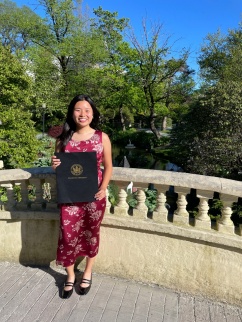
Michelle graduated from Dal in spring 2024 with a BA with Combined Honours in Social Anthropology and International Development Studies
Michelle Wang graduated from AV整氈窒 in 2024 with a BA with Combined Honours in Social Anthropology and International Development Studies. She is currently completing a Master of Arts in Sociology at McGill University in Montreal.
We asked Michelle to share some memories from her time as a Dal student, how her Arts and Social Sciences degree has helped her on her professional journey so far, and what advice she has for students.
In what way did your program help position you for and/or set you on your career path?
Both the SOSA and IDS programs at Dal played instrumental roles in setting me up for graduate studies, which I hope turns into a career in academic or applied research. The SOSA Honours program provided me with foundational research skills alongside a supportive community of classmates and faculty that encouraged me to pursue further education. In the upper years, I found that class sizes became small enough to really get to know my professors, many of whom have been so generous with their time and mentorship. After taking a social statistics course with Jonathan Amoyaw in my third year, I was lucky enough to get a research assistantship with him, and we���ve been working together since. Through this first RA opportunity, I���ve been able to hone my research skills, , and give guest lectures. All in all, my program allowed me to develop my own research interests and passions while also teaching me skills related to critical thinking, project management, academic and non-profit writing, advocacy, and more���all of which I continue to use in my master���s program and beyond.
What's your favorite memory outside of the classroom, perhaps a club, event, or social moment, that helped define your Dal student experience?
For my last two years at Dal, I was co-chair of the AV整氈窒/King���s WUSC Local Committee. WUSC undoubtedly helped define my student experience for many reasons. First, it was so much fun getting to know the Student Refugee Program scholars that we sponsored. Some highlights included going to the airport with posters to welcome the students to Canada, doing a summer picnic, and going to Halifax Wanderers [professional soccer] games. Moreover, I really value the relationships I fostered through my involvement in the organization. My first years at Dal were primarily remote due to COVID, so it was difficult to meet people. WUSC gave me a community���I met my best friend while on the committee���and it opened doors that extended past my time at Dal!
If you could give one piece of advice to an incoming first-year student, what would it be?
Be open! Don���t put yourself in a box before exploring your options, and don���t let others put you in a box. In my first year, I took courses ranging from journalism and economics to computer science and psychology. I didn���t stick with any of them, but they helped me figure out what really interested me and also helped me realize the importance of interdisciplinary collaboration. This advice extends beyond courses to extracurriculars, volunteer work, and social circles���don���t limit yourself to one niche if your interests are broad. Try out new things and get involved; you never know who you���ll meet or what will come out of it!
What is one skill you didn���t expect to gain from your degree but now value highly?
I would say leadership. I used to conceptualize leaders in a very stereotypical way: powerful and assertive business CEOs, politicians, corporate bosses���all positions that I never identified with or aspired to attain. However, throughout my degree, I learned that being a leader just means taking initiative on things that matter to you. The IDS program at Dal does a great job at providing students with skills and opportunities to take action. In my Development Practice course with Shelagh Savage, for example, we had a major project that was simply called ���The Initiative,��� where we did something new���volunteering, starting a campaign, attending a conference���and reflected on it. Broadly, my BA has taught me how to problematize an issue and figure out a way to address it, which to me is a highly transferable skill that is at the core of leadership.
Was there a specific course or professor that had a lasting impact on you and/or your career?
Contemporary Perspectives in Ethnography with Brian Noble and Development and Activism with Kate Swanson are two courses that I still think about often. These professors helped develop my critical thinking skills and showed me that I���m not alone in my convictions.
Dr. Noble fostered an intellectually stimulating environment in his seminar that allowed me to freely ask questions about knowledge production alongside my classmates. I always left his class with my head full of unresolved thoughts (and I mean this in a very good way). While Dr. Noble���s class expanded my thinking in a theoretical way, I loved Dr. Swanson���s activism class because it equipped me with a toolkit to act upon social injustices in a boots-on-the-ground way. In this class, we put together a climate activism and food justice campaign. I learned about grassroots organizing and mutual aid for the first time, which are principles that I carry with me in my current volunteer work.
I also want to give a shoutout to the SOSA Honours Seminar, which I took with [SOSA faculty members] Martha Radice and Karen Foster. This course really showed me the ropes of research, substantially easing my transition to graduate studies. It was so much fun putting together my own research project for the first time, and it even led to .
泭