

THE SNAPSHOT
AV¾ãÀÖ²¿ robotics and underwater acoustics researcher Dr. Mae Seto is working with Defence Research & Development Canada (DRDC) to develop intelligent autonomous sensing systems that can extend the reach of the Canadian Armed Forces in the Arctic and help Canada protect its sovereignty in remote, harsh maritime environments.
THE CHALLENGE: Where sovereignty depends on persistent awareness
Ensuring Canadian sovereignty from coast to coast to coast is no easy task. The vast, turbulent waters that surround the country can be unforgiving for any service member assigned to patrol them — and that’s only when sea ice does not render them unnavigable altogether.
Yet the need for awareness about what is passing through the 12-nautical-mile limit of Canada’s territorial waters is more urgent than ever as sea ice melts, giving way to increased traffic in previously inaccessible waters. As Prime Minister Mark Carney said in a June 2025 speech, Canada aims to “defend every inch of our sovereign territory, from the seafloor to the Arctic to cyberspace.�
For DRDC researchers working to support the Canadian Armed Forces, the challenge to increase our knowledge of what is happening at sea quickly, reliably, and persistently is ever-present.
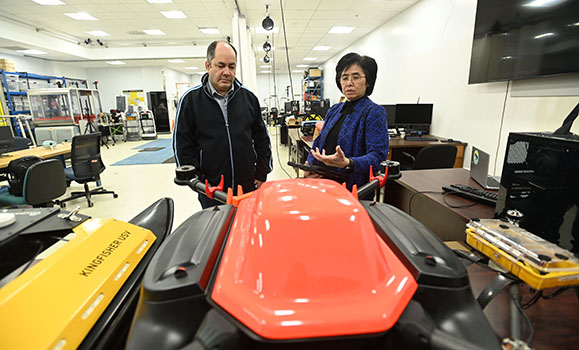
Dr. Seto, right, and Mechanical Engineering PhD candidate Artorix de la Cruz discuss the merits of an autonomous drone that can land on water and perform measurements.ÌýÌý(Danny Abriel image)
“Our Navy and Air Force have finite resources,� says Dr. Stéphane Blouin, a DRDC scientist who has partnered with Dr. Seto extensively to improve sensing and surveillance technology. “We have to cover a lot of ground, a lot of ocean. When we are sending just one vessel on a mission, it has a limited footprint.�
 And sometimes sending even one vessel isn’t possible, he says. Some missions require weeks or even months of watchful presence in remote waters, often with long periods when little appears to be happening but awareness still matters. In the Arctic, those demands are compounded by darkness, extreme weather and sea ice that can make it difficult, unsafe or impractical to keep aircraft or ships continuously in place.
“The idea is to leverage modern technology, like autonomous systems, to build synergy with our traditional naval assets,� Dr. Blouin says. “You can send them ahead of where you’re going or deploy them in one area and go off and cover another area.�
THE SOLUTION:
Dr. Seto’s lab is helping to build the autonomous technologies and capabilities needed to cast the much broader surveillance net needed to catch what is passing through Canada’s waters.
Her research program with DRDC and NATO partners focuses on autonomous sensing and navigation – systems that collect information in harsh environments, process what they find and make decisions about how to continue when they cannot communicate well with a human operator.Ìý
Like onboard brains, the sensors, underwater acoustic communications, and autonomy her team develops bring intelligence to unmanned systems under the ocean, on its surface, and from above the water, allowing them to communicate amongst themselves so they can collaborate as a network or team. The underwater systems can have near indefinite endurance by docking to underwater or seabed-based recharging/data download nodes.
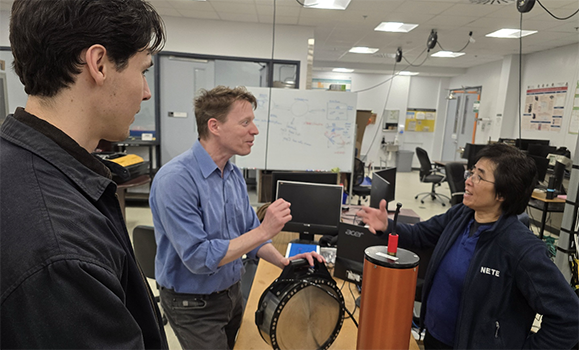
Dr. Stephane Blouin, centre, and Dr. Seto in the lab withÌýJacob Flaherty, an M.A.Sc. candidate in Electical and Computer Engineering.Ìý
“The unmanned systems are just platforms or hosts for our sensors,â€� Dr. Seto says. “At the end of the day, it’s all about what the sensor can measure. It requires that you have a system that is intelligent, it can act autonomously (through its autonomy) to adapt its mission, adjust sensor parameters,Ìý make the sensor measurements, process the measurements, interpret the measurements, collaborate with other systems, and make decisions on-board to meet the mission goals given the very harsh environments they operate in.â€�
THE WORK: Giving unmanned systems a mind of their own
Once an autonomous vehicle slips beneath the ocean’s surface, it enters a world where the usual rules of communication no longer apply. The deeper a vehicle goes, the more alone it becomes. Radio signals cease to work so underwater acoustic signals are used instead. Data streams slow to a trickle. Even the most basic message becomes challenging to send.
“When we transfer information from a surface modem to an underwater vehicle, or vice versa, we’re able to send less than half of a text message back and forth,� says DRDC Research Engineer Sean Spears. “We certainly don’t have the ability to provide a video stream so that we know where the vehicle is and how the vehicle is operating.�
That limitation presents a significant engineering problem. If a person cannot steer the vehicle, the vehicle needs more capacity to decide for itself through its on-board autonomy. Working with DRDC, Dr. Seto’s group combines sensing technologies, underwater acoustics signal processing, machine learning models, robotic collaboration in its on-board autonomy software and in-water platform testing to build the autonomous systems capabilities required.
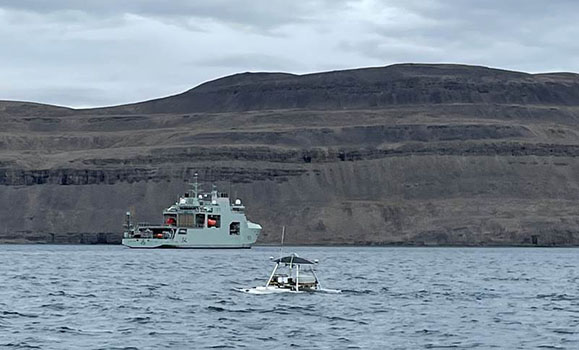
Dr. Seto works with the DRDC autonomous surface vehicle in the Canadian Arctic near the Gascoyne Inlet Camp. (Steven Berry photo)
“It has made us evolve beyond the paradigm of pre-scripted missions,� Spears says. “We allow the operator to still be in the loop, but we are pushing more of the in-situ decision making to the platform. It allows the vehicle to perceive its environment, to reorient itself, to optimize where it needs to go and how it needs to do it.�
One focus of the collaboration has been software that allows different autonomous platforms to work together. Spears describes a DRDC collaborative autonomy framework that draws on Dr. Seto’s applied research and can interface across multiple vehicles, sensor models and mission capabilities, including interoperability with NATO systems.
THE IMPACT: Turning awareness into advantage
Building these persistent autonomous sensing and communication networks with strategic allies is what will give Canada the capacity and scale to defend our sovereignty in the Arctic, says Dr. Seto.
“The ability to get information and situational awareness to those who need it in a timely manner is very important,â€� she says.Ìý“The people who can acquire the sensor measurements, interpret them and pass it on to those who can action them the fastest have the advantage.â€�ÌýÌý
In the meantime, Blouin says the small autonomous systems DRDC is developing with Dr. Seto can help cover the gaps between high-value traditional assets like ships and land-based infrastructure, gather information through long and difficult missions, and help identify and track increasing maritime activity.
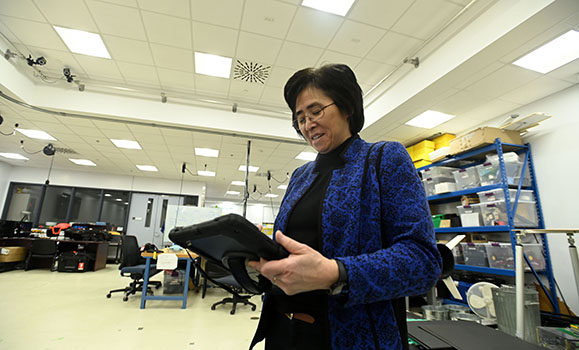
Dr. Seto examines results from a recent underwater acoustics test.
“It’s a collective effort of smaller, smart systems, and they talk to one another to pass this kind of data,� Blouin says. “Together, they figure out: this is okay, this is not looking quite normal.�
For AV¾ãÀÖ²¿, the work demonstrates a research capability increasingly relevant to Canada’s security and sovereignty priorities – the ability to work at the intersection of ocean science, engineering, artificial intelligence and real-world defence requirements.
“There’s definitely a sovereignty aspect,� Dr. Blouin says. “There won’t be a sustained land-based human presence in key areas of the Arctic for quite some time. The only way we can close a gap is by dropping these kinds of unmanned systems in our waters and putting them to work.�